
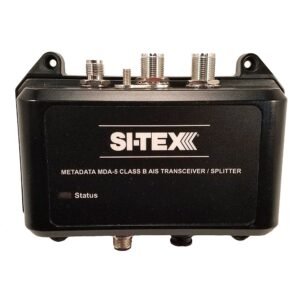
Raymarine AIS700 Class B AIS Transceiver w/Antenna Splitter

The Raymarine AIS700 combines Class B AIS transmission and reception with an integrated antenna splitter. This arrangement helps vessels broadcast identification data, receive nearby targets, and share a VHF antenna installation, improving traffic visibility while reducing the number of separate components.
RAYMARINE AIS700 Class B AIS Transceiver (w/ Splitter) Specifications
| Communication Type | Class B+ SOTDMA AIS Transceiver |
| AIS Class/Protocol | SOTDMA (Self-Organizing TDMA) |
| Output Power | 5W Output Capacity |
| Frequency Range | 156.025 – 162.025 MHz |
| Reporting Rate | Up to Every 5 Seconds (Speed Dependent) |
| Operating Voltage | 12V / 24V DC Support |
| Current Draw | < 3A Peak / 220mA Average |
| Interface/Networking | NMEA 2000, NMEA 0183 (x2), USB Interface |
| Internal GPS | 72-Channel Integrated GNSS Receiver |
| Display Type | Multi-Color LED Status System |
| Waterproof Rating | IPX6 & IPX7 Rated Protection |
| Operating Temperature | -25°C to +55°C Marine Grade |
| Length (Overall) | 210 mm (8.2") Chassis |
| Width/Diameter | 199 mm (7.8") Body Width |
| Weight | 0.79 kg (1.7 lbs) |
| Included Accessories | External GPS Antenna, Power/Data Cable, N2K Drop Cable |
| Key Mechanical Feature | Integrated VHF splitter with hardware-fail safe bypass |
Common Question of Raymarine AIS700
What is the AIS700?
The Raymarine AIS700 is a Class B AIS transceiver with an antenna splitter according to the listing. It transmits and receives compatible vessel data. Confirm GPS, VHF antenna, display, splitter connections, power supply, wiring, programming, and Class B AIS transceiver compatibility before installation.
What does the antenna splitter do?
The antenna splitter allows compatible AIS and VHF equipment to share an antenna system. Confirm coaxial connections, grounding, splitter power, antenna specifications, GPS source, display, and Raymarine network compatibility before commissioning.
Does it require vessel programming?
Yes. AIS transceivers require accurate vessel-specific identification and static data, including the MMSI and related information. Use authorized programming procedures and verify every entry before transmission. Incorrect data can compromise vessel identification and traffic awareness.
You must be logged in to post a review.
Related products




Reviews
There are no reviews yet.